
in quantum physics what is an "observer"
Timeline
Post
Remote status
Replies
12


@raccoon can’t watch video now

@sun as far as i understand it, anything which changes the velocity or position - any measurement of the state requires per definition interaction between the object that is measured and the tool used for measurement. observer is just a shitty term imo, if a particle crashes into another one that is also "measuring" it's properties.

@sun
there's no coherent definition because wave-function collapse as a concept is incoherent, product of mind-projection fallacy (i don't know the state, and therefore it has no state
to be very short, bell's theorem indicates that "locality", the idea of space as smooth-continuous-manifold, is incompatible with quantum phenomena. and, rather than accept that, physicists generally go into denialist handwaving, with their platonic smoothbrane ideals spontaneously changing into disjunct world when "measured", whatever that nonspecifically and self-incompatibly means
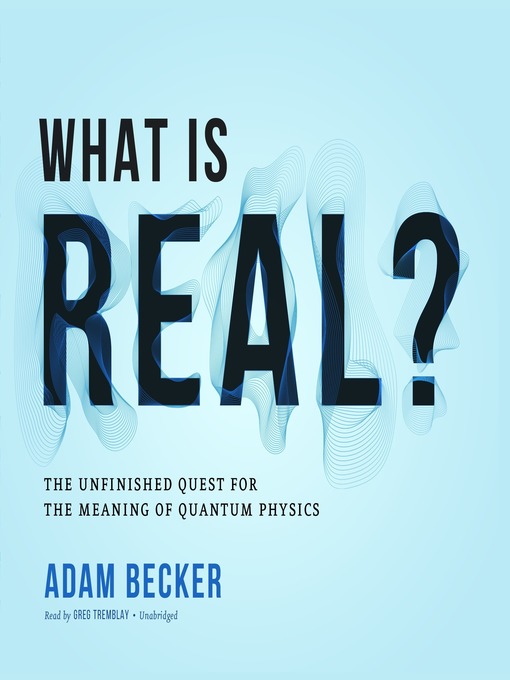
p rel is a nice popular-audience book about quantum foundations muddle, though even he doesn't talk this aspect quite directly don't think
Adam Becker - What Is Real.jpg
there's no coherent definition because wave-function collapse as a concept is incoherent, product of mind-projection fallacy (i don't know the state, and therefore it has no state
to be very short, bell's theorem indicates that "locality", the idea of space as smooth-continuous-manifold, is incompatible with quantum phenomena. and, rather than accept that, physicists generally go into denialist handwaving, with their platonic smoothbrane ideals spontaneously changing into disjunct world when "measured", whatever that nonspecifically and self-incompatibly means
p rel is a nice popular-audience book about quantum foundations muddle, though even he doesn't talk this aspect quite directly don't think
Adam Becker - What Is Real.jpg


@sun depends on what interpretation you subscribe to.
The fact of the matter is, these "interpretations" of quantum physics are different theories altogether, some predicting different things than others. In the many-worlds theory by Everett, there is no such thing as an observer, but there are entanglement and decoherence. You could say that an "observer" is someone or something entangled with the quantum system that he "observes".
The fact of the matter is, these "interpretations" of quantum physics are different theories altogether, some predicting different things than others. In the many-worlds theory by Everett, there is no such thing as an observer, but there are entanglement and decoherence. You could say that an "observer" is someone or something entangled with the quantum system that he "observes".


@sun an observer is the object or energy with which you perturb a physical property of an object or phenomenon
you need to be aware of heisenberg's uncertainty principle to understand what an observer is
he proved that it is impossible to accurately measure both the position and velocity of a particle or phenomenon. In order to measure one, you must necessarily interfere with the other and your interference will effect the thing you are measuring.
For example, if you want to see a can of Monster energy drink, you need to bounce light off the can and receive it with your eyes. This alters the state of the can (it might move it slightly, or warm it up, etc). In this case the observer would be the light itself
if you were probing a surface with a hard diamond tipped probe to measure its flatness, the observer would be the tip of the diamond-tipped probe
if you were setting up Muon detectors to find voids in the Great Pyramid, the observers would be the muons
the process of altering the state of the object or phenomena to measure its property is called observation
you need to be aware of heisenberg's uncertainty principle to understand what an observer is
he proved that it is impossible to accurately measure both the position and velocity of a particle or phenomenon. In order to measure one, you must necessarily interfere with the other and your interference will effect the thing you are measuring.
For example, if you want to see a can of Monster energy drink, you need to bounce light off the can and receive it with your eyes. This alters the state of the can (it might move it slightly, or warm it up, etc). In this case the observer would be the light itself
if you were probing a surface with a hard diamond tipped probe to measure its flatness, the observer would be the tip of the diamond-tipped probe
if you were setting up Muon detectors to find voids in the Great Pyramid, the observers would be the muons
the process of altering the state of the object or phenomena to measure its property is called observation